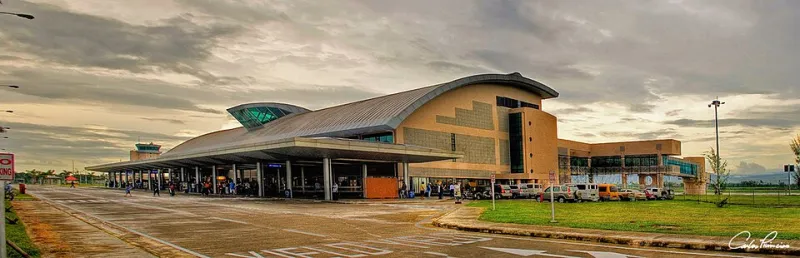
Small Airport, Big Welcome: Why BCD Is Winning Over US Solo Travelers and Digital Nomads

Photo: Brocken Inaglory.Edit by User:Richard Bartz, CC BY-SA 4.0, via Wikimedia Commons
There is a particular kind of traveler who has quietly been rerouting their Philippine itinerary over the past several years. They are not the package-tour crowd or the beach-resort regulars who fly straight into Boracay. They are US-based digital nomads, solo female travelers, and independent adventurers who have done their research, read the forums, and arrived at the same conclusion: Bacolod-Silay Airport might be the most underrated entry point in the entire Philippine archipelago.
The reasons are worth exploring in depth.
The Case Against Arriving in Manila First
For most Americans flying to the Philippines, Ninoy Aquino International Airport in Manila is the default gateway. It is the most connected hub, the most frequently served by US carriers, and the most familiar name on the itinerary. It is also, by nearly universal traveler consensus, one of the most stressful airports in Southeast Asia to navigate on arrival.
Terminal confusion, long immigration queues, inconsistent signage, aggressive taxi touts, and the sheer volume of passengers moving through the facility on any given day create an arrival experience that can overwhelm even seasoned international travelers. For someone flying solo from the United States for the first time—or for a woman traveling independently who is already managing the mental load of personal safety awareness—Manila's chaos is a real and legitimate deterrent.
Mactan-Cebu International Airport is somewhat more manageable, but Cebu City itself presents its own logistical challenges for first-timers: heavy traffic, a sprawling urban layout, and a tourism infrastructure that can feel impersonal and transactional.
BCD, by contrast, offers something increasingly rare in modern air travel: a genuinely calm arrival.
What Makes BCD Different for Independent Travelers
Bacolod-Silay Airport is a single-terminal regional facility. You will not spend 20 minutes on a shuttle bus between concourses. You will not queue for 90 minutes at immigration behind three wide-body international flights. The baggage claim area is compact and functional, the exit is clearly marked, and legitimate transportation options are available immediately outside the arrivals door.
For solo travelers—and particularly for women arriving alone after a long-haul journey—the psychological difference between stepping out of BCD and stepping out of NAIA Terminal 3 is substantial. The environment is legible. The scale is human. The experience of arriving feels manageable rather than overwhelming.
Accredited airport taxis and ride-hailing services through Grab (the dominant app-based transport platform in the Philippines) are readily accessible from the terminal. Drivers in the Bacolod-Silay area are, by general traveler consensus, notably courteous compared to their counterparts in larger Philippine cities. Fixed-rate airport taxis eliminate the negotiation anxiety that plagues arrivals at less regulated terminals.
Safety in Negros Occidental: What the Data and Experience Suggest
No travel guide should offer unconditional safety guarantees about any destination, and this one will not. However, Negros Occidental—and Bacolod City in particular—carries a consistently strong reputation among both Filipino and international travelers for being among the more livable and low-hassle provinces in the country.
US women who have based themselves in Bacolod frequently describe the city as one where they feel comfortable walking in commercial areas during the day, dining alone at restaurants, and using public transportation without the persistent harassment that can characterize travel in some other Southeast Asian urban centers. The Bacolodnon cultural character—warm, family-oriented, and genuinely hospitable—creates a social environment that many independent travelers find disarming in the best possible sense.
The US Embassy in Manila does maintain travel advisories for specific regions of the Philippines, and travelers are always encouraged to review current guidance before departure. Negros Occidental itself does not appear on elevated advisory lists, and the province's tourism infrastructure has developed substantially in recent years to support independent visitors.
The Digital Nomad Equation: Cost, Connectivity, and Community
For US-based remote workers weighing their options among Southeast Asian bases, Bacolod presents a financial argument that is difficult to ignore. Monthly living costs for a comfortable lifestyle—quality apartment rental, reliable internet, dining out regularly, local transportation—consistently run well below comparable arrangements in Bali, Chiang Mai, or even Ho Chi Minh City, all of which have become saturated with the digital nomad demographic.
Bacolod's co-working scene, while not as large as those in Cebu or Manila, has grown meaningfully. Established spaces offer stable fiber connections, professional environments, and the kind of focused working atmosphere that crowded tourist-town cafés cannot reliably provide. Many remote workers report that the relative lack of a transient expat crowd—compared to, say, Canggu—is itself an asset: the community that does form tends to be composed of people who chose Bacolod deliberately, which creates a more substantive social environment.
English is widely spoken throughout Negros Occidental, a function of the Philippines' colonial history and its continued emphasis on English-language education. US travelers will encounter no language barrier of significance in Bacolod, which substantially reduces the cognitive load of daily life for new arrivals.
Navigating BCD as a First-Timer: Practical Orientation
For travelers arriving at BCD for the first time, a few practical notes will help orient the experience. The terminal layout is linear and intuitive; arrivals, baggage claim, and the exit to ground transportation follow a logical sequence that requires no advance research to navigate. Airport staff are generally responsive to questions from passengers who appear uncertain.
SIM card acquisition is one of the first priorities for any independent traveler arriving in the Philippines. Major carriers including Globe and Smart have retail presence in Bacolod City, and tourist SIM packages with data allowances are straightforward to purchase. Having mobile data active before leaving the airport area allows immediate access to Grab for transportation, Google Maps for navigation, and communication apps for coordination.
The drive from BCD to central Bacolod takes between 20 and 40 minutes depending on traffic and the specific destination. The National Highway corridor connecting Silay to Bacolod passes through productive sugarcane country—a visual introduction to the agricultural identity of Negros Occidental that no amount of pre-trip reading quite prepares you for.
A Gateway That Matches the Destination
There is a coherence between the airport and the city it serves that seasoned travelers will recognize as a genuine asset. Bacolod is not a place that overwhelms on arrival. It reveals itself gradually, through conversations with locals, through meals eaten without a tourist menu in sight, through the unhurried pace of a city that is proud of itself without needing to perform for outsiders.
For US solo travelers and digital nomads seeking a Philippine entry point that respects their time, their nerves, and their budget, BCD is not a compromise. It is, increasingly, the deliberate choice.