Inside BCD: A Passenger's Guide to Bacolod-Silay Airport's Infrastructure, Upgrades, and What to Expect on Arrival
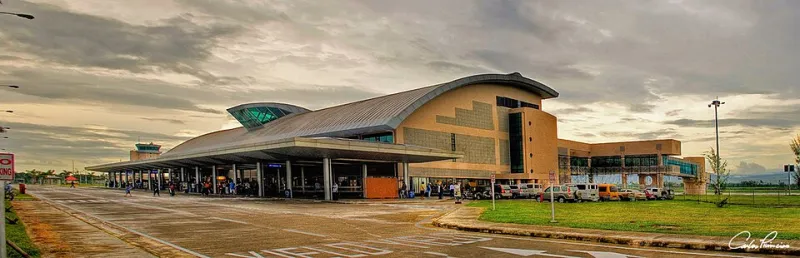
Photo: Carabaopower (talk) (Uploads), CC BY 3.0, via Wikimedia Commons
First impressions of Bacolod-Silay Airport (IATA: BCD) often surprise American travelers who arrive expecting a small, underdeveloped regional airstrip. What they find instead is a purpose-built international facility that opened in 2008, designed from the ground up to replace the old Bacolod Domestic Airport and serve as a genuine gateway to Negros Occidental. The airport sits in the municipality of Silay—roughly 14 kilometers north of Bacolod City's urban center—and its modern design reflects ambitions that go well beyond handling regional commuter traffic.
Understanding what BCD is, how it operates, and where its current limitations lie is genuinely useful information for any US traveler planning to pass through. The details matter.
The Terminal Layout: Compact but Functional
BCD operates as a single-terminal facility. The building is organized across two primary levels: the departure hall occupies the upper floor, while arrivals processing, baggage claim, and ground transportation access are managed on the lower level. This vertical separation is straightforward and, for first-time arrivals, reasonably intuitive to navigate.
The departure hall contains the check-in counters for all operating carriers—currently Cebu Pacific, Philippine Airlines, and AirAsia Philippines—along with a security checkpoint, a modest retail and food and beverage zone, and the departure gates. The gate area is air-conditioned and adequate for the volume of passengers the airport typically handles, though peak holiday periods can make seating scarce. Travelers departing on early morning flights, which are common on the BCD-Manila route, will find limited food options before approximately 6:00 a.m.
The arrivals level is compact. Baggage claim involves a small number of carousels, and the flow from aircraft to baggage to exit is short by international standards. For passengers arriving on domestic Philippine flights—which constitute the majority of BCD's traffic—the process from touchdown to the taxi stand typically takes between 20 and 35 minutes under normal conditions.
International Capabilities: What BCD Can and Cannot Handle
BCD holds international airport designation, which means it is equipped with customs, immigration, and quarantine (CIQ) facilities. This is an important distinction. The airport has processed international charter flights and has the infrastructure to handle direct international arrivals when they are scheduled.
However, for the foreseeable future, US travelers will not arrive at BCD on an international flight. There are currently no scheduled international services operating into Bacolod-Silay. All arriving passengers from the United States will clear Philippine immigration and customs at their first port of entry—Manila or Cebu—and then proceed to BCD on a domestic connecting flight. This means your BCD arrival experience is a domestic one: no customs queue, no immigration line, no quarantine inspection. You collect your bags and walk out.
This operational reality is worth understanding before arrival. Many travelers who have just endured a 14-plus-hour transpacific flight followed by a domestic connection arrive at BCD expecting another round of formal processing. There is none. The simplicity is welcome.
Baggage Handling: Realistic Expectations
BCD's baggage handling operation is functional but operates at a pace that reflects the airport's scale rather than the urgency of a major hub. On domestic arrivals, baggage delivery to the claim carousel typically begins within 15 to 25 minutes of the aircraft parking. During peak periods—holiday weekends, Masskara Festival season in October, and Holy Week—this timeline can extend.
For travelers connecting from international flights through Manila or Cebu, it is important to confirm with your airline whether your checked baggage is tagged through to BCD or requires rechecking at the connecting hub. Philippine Airlines typically offers through-check on itineraries it operates end-to-end. On separately ticketed itineraries—which, as discussed in other articles on this site, are often the more economical choice—you will collect and recheck your bags at the Manila or Cebu connection point. Allow adequate layover time for this process.
Modernization Projects and Recent Investments
The Civil Aviation Authority of the Philippines (CAAP) and the Bases Conversion and Development Authority (BCDA), which manages BCD under a joint arrangement, have pursued a series of infrastructure improvements at the airport over recent years. Runway rehabilitation works have been completed to bring the primary runway into full compliance with international safety standards, a project that required temporary operational adjustments and is now concluded.
Terminal expansion discussions have been part of the airport's long-range planning, driven by growth in passenger volumes as Bacolod's profile as both a tourist and business destination has risen. The Negros Occidental provincial government and Bacolod City have both advocated for expanded international connectivity, and BCD's infrastructure is being positioned to support that goal should direct international routes materialize.
For the arriving US traveler, the practical result of these investments is a facility that handles its current traffic volume with reasonable efficiency and is not showing the strain of being significantly under-resourced relative to demand.
How BCD Compares to Other Philippine Regional Airports
Placing BCD in context helps calibrate expectations. It is a more capable facility than airports serving comparable Philippine cities—better resourced than, for example, Dumaguete (DGT) or Roxas (RXS), and roughly comparable in scope to Iloilo (ILO), which serves a similarly sized Visayan city. It is smaller and less complex than Mactan-Cebu International or Clark International, and operates at a fraction of the volume of Manila's NAIA.
This positioning is actually an advantage for the arriving passenger. BCD does not have the chronic congestion, extended taxi times, or systemic delays that characterize Manila's airport system. Flights generally depart and arrive close to schedule. Ground transportation is immediately accessible outside the arrivals exit. The experience is efficient in a way that larger Philippine hubs often are not.
Ground Transportation: The First Decision After Baggage Claim
Exiting the arrivals level at BCD, travelers encounter a taxi stand, ride-hailing pickup zones, and—for those who have arranged it in advance—hotel or resort shuttle services. The road distance to central Bacolod is approximately 14 kilometers, and travel time to the city center ranges from 20 to 40 minutes depending on traffic. The expressway connection has substantially improved this journey compared to the old surface road routing.
For American expats relocating to Negros Occidental, or for travelers planning extended stays, arranging airport pickup through an accommodation provider or a trusted local contact is strongly recommended for the first arrival. Orienting yourself to BCD's ground transport options is straightforward once you have done it once, but the first time—after 20-plus hours of travel—is not the ideal moment to figure it out from scratch.
What the Airport Tells You About the Region
Bacolod-Silay Airport is, in many respects, a physical expression of Negros Occidental's ambitions. It was built not for the region as it was, but for the region as its planners expected it to become. That forward orientation—a modern terminal in a city that rewards the traveler who looks past first impressions—turns out to be an apt introduction to Bacolod itself. Knowing what the airport can do, and what it is still working toward, prepares you not just for a smoother arrival, but for a more informed engagement with everything that comes after you walk out the door.