Corporate Travel, Reimagined: Why US Business Delegations Are Routing Philippines Operations Through Bacolod-Silay Instead of Manila
Photo: PerpetualTraveler, CC BY-SA 4.0, via Wikimedia Commons
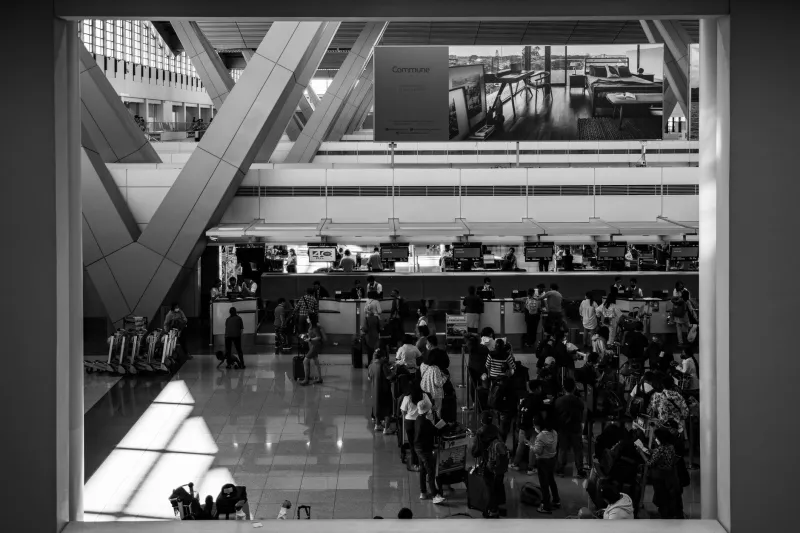
For decades, the default itinerary for US executives heading to the Philippines has followed a familiar script: land at Ninoy Aquino International Airport, absorb the chaos of Metro Manila traffic, check into an Ayala or BGC hotel at a premium nightly rate, and spend the first half of the trip recovering from the journey itself. It is a routine that works—but only because most travelers have never seriously considered the alternative.
Bacolod-Silay Airport (BCD) is changing that calculus. Quietly and without much fanfare, a growing number of US-based companies with operations or supplier relationships in the Visayas region are restructuring their Philippines travel programs to route through Negros Occidental instead of Metro Manila. The results, by nearly every measurable standard, are favorable.
The Hidden Cost of Manila as a Default Hub
Manila's dominance as a Philippine entry point is understandable from a historical standpoint. It is the country's largest city, its commercial capital, and the seat of most national government agencies. For companies whose Philippines business is genuinely Manila-centric, the traditional routing makes sense.
But for organizations with operations in the Visayas—sugar and agribusiness firms, food manufacturing companies, renewable energy developers, business process outsourcing groups based in Bacolod, and resort or hospitality operators across the island chain—Manila is often a detour rather than a destination. Routing through NAIA adds not just a connection flight but also the unpredictability of Metro Manila ground transport, where a 15-kilometer drive can consume two hours depending on the time of day.
When you factor in a missed afternoon meeting, a hotel upgrade necessitated by an unexpected overnight stay, and the accumulated fatigue of a multi-leg journey that could have been shorter, the true cost of the Manila default becomes clearer.
What BCD Offers the Business Traveler Specifically
Bacolod-Silay Airport's advantages for corporate travelers are distinct from its general appeal to tourists or digital nomads. Several factors are particularly relevant to the business use case.
Predictable ground transit times. Bacolod's urban core is compact relative to Metro Manila. The drive from BCD to the central business district—including the Lacson Street corridor and the emerging Northgate Cyberzone—runs between 20 and 35 minutes under normal conditions. That predictability is operationally significant. A business delegation can schedule a late-morning arrival and realistically hold a lunch meeting the same day.
Accommodation costs that favor the travel budget. Bacolod's hotel market offers solid four-star options at rates that consistently undercut comparable Manila properties. Business-class hotels in Bacolod typically run between $70 and $120 per night, versus $150 to $250 or more for equivalent accommodations in BGC or Makati. For a team of six traveling for five nights, that differential can represent thousands of dollars in savings—money that stays in the operating budget rather than disappearing into accommodation overhead.
A smaller, faster airport experience. BCD handles a fraction of the passenger volume that NAIA processes daily. Check-in queues are shorter. Security lanes move efficiently. Departures are rarely delayed by the kind of systemic congestion that plagues larger hubs. For corporate travelers who value their time above nearly everything else, the ability to arrive at BCD 45 minutes before a domestic departure—rather than the two-hour buffer NAIA demands—is a genuine quality-of-life improvement.
Real-World Routing Scenarios
Consider a US-based food ingredients company with a supplier relationship in Negros Occidental's sugar belt. Their procurement team historically flew into Manila, spent a night recovering, took a domestic connection to Bacolod the following morning, and finally reached their supplier by early afternoon of day two. By shifting to a routing that connects through Cebu or Manila with a same-day onward flight to BCD—or increasingly, exploring direct regional connections—the team now arrives in Bacolod on the evening of day one, holds their supplier meetings across day two, and departs on day three. A five-day trip becomes a three-day trip.
Or consider a renewable energy development firm conducting site assessments across Negros Occidental and Negros Oriental. Their field team previously staged out of Manila, adding unnecessary transit time on both ends of each site visit. Repositioning their base of operations to Bacolod—using BCD as their primary entry and exit point—cut their total in-country travel time by roughly 30 percent across a two-week project cycle.
These are not exceptional cases. They reflect a structural logic that applies to any organization whose Philippines work is Visayas-focused.
The Logistics Stack: What Corporate Travel Managers Should Know
For US travel managers evaluating BCD as a primary routing option, several practical considerations are worth noting.
Domestic connections from Manila to Bacolod are frequent throughout the day, operated primarily by Cebu Pacific and Philippine Airlines. Flight time is approximately one hour. The connection works well when the international arrival clears immigration with sufficient buffer—generally two to three hours minimum. BCD's domestic terminal is straightforward to navigate, with ground transport options including metered taxis, ride-hailing services, and hotel shuttles readily available at the exit.
For groups requiring meeting facilities upon arrival, several Bacolod hotels maintain dedicated business centers and conference rooms that can be reserved in advance. The L'Fisher Hotel, the Planta Hotel, and newer properties in the Northgate district all cater specifically to corporate clientele.
For delegations requiring ground transport across the island—to visit sites in Sagay, Victorias, or San Carlos—vehicle hire is available through established local operators, and road infrastructure in Negros Occidental has improved substantially in recent years.
The Broader Shift in Philippine Business Geography
Bacolod is no longer simply a sugar capital with a famous chicken inasal. The city has developed a meaningful BPO sector, a growing technology services cluster, and a hospitality industry that increasingly attracts regional and international business events. The Negros Showroom and various trade and investment promotion offices have made sustained efforts to position the province as a destination for foreign direct investment.
For US companies that have been watching this evolution, the practical implication is straightforward: the infrastructure required to conduct serious business in Bacolod—reliable hotels, functional meeting facilities, stable internet connectivity, and accessible air service—is now firmly in place.
Making the Case Internally
If you are a US-based executive or travel manager considering this routing shift, the internal case is not difficult to build. Compile the accommodation cost differential, model the ground transit time savings, and calculate the reduction in total trip duration. Present those figures alongside the operational reality that your team will arrive at their destination less fatigued and more prepared.
The Manila default persists largely because it is familiar, not because it is optimal. For Philippines business travel with a Visayas focus, Bacolod-Silay Airport offers a more efficient, more economical, and genuinely more comfortable entry point. The companies already using it have noticed. The question is whether yours will be next.